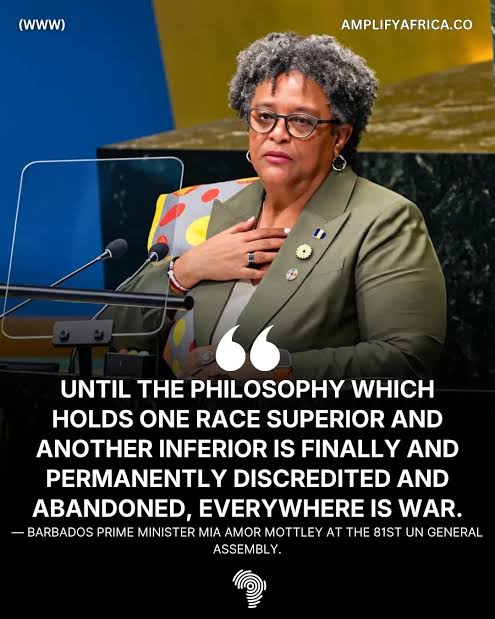
Mia Amor Mottley
By Comrade Olatunji Olorunfemi (Awokoworldwide), FCILMMD
Writes from Iloko-Ijesa
Some speeches are delivered because protocol demands it. Others are delivered because history is watching.
And then there are speeches that deserve to live beyond the moment in which they were delivered.
For me, the address by the Prime Minister of Barbados, Mia Amor Mottley, at the 81st United Nations General Assembly belongs firmly in that category.
It was not merely a speech about Barbados. Neither was it simply a Caribbean intervention at a global gathering. It was, in many respects, a conversation with humanity—a warning about where we are heading, a challenge to those in positions of power and, most importantly, a reminder that the decisions being made today will become the inheritance of generations yet unborn.
That is why I believe the speech deserves much more than applause.
It deserves to be heard.
It deserves to be discussed.
It deserves to be taught.
And it deserves to be preserved.
Beyond Words and Protocol
One of the most powerful elements of Mottley’s message was her challenge to the world to move from knowledge to action.
We live in an age where humanity knows more than ever before. We know the dangers posed by climate change. We understand the widening gap between the rich and the poor. We know that global institutions require reform. We are witnessing the rapid rise of artificial intelligence. We know the devastating consequences of wars and conflicts.
Yet knowing is not the same as acting.
The world has become remarkably good at identifying problems and remarkably slow at confronting some of them.
This is where political leadership matters.
Leadership is not simply about making speeches. It is about making difficult choices when those choices are unpopular, expensive or politically inconvenient.
Mottley’s address, therefore, should not be treated as another diplomatic statement that disappears from public consciousness once the cameras are switched off.
It should provoke a conversation.
And What About Our Children?
This is where the speech becomes particularly important to me.
Our children did not create most of the problems confronting the world today. Yet they will inherit many of the consequences.
The child sitting in a classroom today will grow up in the world shaped by today’s decisions on climate, technology, artificial intelligence, education, inequality, peace and economic development.
That child deserves to know what the adults in positions of authority are saying about his or her future.
This is why I strongly believe that speeches of this nature should find their way into our schools—not as political propaganda, but as educational material.
Let our young people listen to the speech.
Let teachers break down its ideas.
Let students debate its arguments.
Let them ask uncomfortable questions.
Let them disagree where necessary.
Let them understand that the United Nations is not some distant institution somewhere in New York, Geneva or elsewhere, but a forum where decisions and conversations can ultimately affect the price of food, the quality of education, the security of communities, employment opportunities, technology and the environment in which they will live.
Education should not only prepare children to pass examinations. It should prepare them to understand the world they are inheriting.
We Must Preserve the Record
There is another reason this speech should not be allowed to disappear into the enormous archive of global speeches.
History is not only made through wars, elections and treaties.
Sometimes, history is captured in words.
Future generations will inevitably ask questions of our generation:
What did you know?
What warnings did you receive?
What did your leaders say?
And what did you do about them?
The answers will partly exist in speeches such as this.
That is why proper archiving matters.
A speech may last for less than an hour, but its ideas can survive for decades. A recording, transcript or school discussion may become an important historical reference for someone trying to understand the concerns and priorities of our generation.
We should therefore stop treating important speeches as disposable media content.
Not everything should be consumed today and forgotten tomorrow.
Some words deserve preservation.
What Are We Leaving Behind?
There is a tendency for every generation to measure its achievements by what it has built.
We celebrate roads, skyscrapers, technology, institutions and economic growth.
But perhaps we should ask a deeper question:
What kind of world are we leaving behind?
A generation can leave behind impressive buildings and still leave behind a broken society.
It can create extraordinary technology and still fail to create justice.
It can accumulate wealth and still leave millions behind.
It can develop artificial intelligence and still struggle with basic human compassion.
Development without responsibility is not necessarily progress.
That is the conversation we should be having.
And that is why Mottley’s message deserves to travel beyond the walls of the United Nations.
A Message for Africa Too
For Africa, the message carries an even greater significance.
We are a continent with one of the world’s youngest populations. The future of Africa will largely be determined by what we teach our young people, what opportunities we create for them and the kind of leadership we provide today.
Our children must not merely inherit our problems.
They must inherit the courage, knowledge and imagination required to solve them.
They should learn to question leadership without disrespecting authority.
They should learn that patriotism does not mean silence.
They should understand that development is about people, not merely projects.
And they should know that the future does not belong exclusively to those occupying political offices today.
The future belongs to them.
Let the Speech Live
Perhaps, therefore, the most fitting response to a speech of this nature is not simply to praise the speaker.
It is to continue the conversation.
Play it in schools.
Discuss it in universities.
Analyse it in newsrooms.
Debate it in civic forums.
Translate its ideas into languages ordinary people understand.
Archive it for researchers and generations yet unborn.
And, above all, challenge our leaders to turn noble words into meaningful action.
Because speeches are powerful, but action is what ultimately gives speeches meaning.
Some speeches are made for an audience.
Some are made for a generation.
And some are made for history.
For me, Mia Amor Mottley’s United Nations address belongs in that final category.
The world should listen.
Our children should learn from it.
And history should not be allowed to forget it.
I-INFORM | I-MOTIVATE | I-EDUCATE
Comrade Olatunji Olorunfemi (Awokoworldwide), FCILMMD
Writes from Iloko-Ijesa